English/ELA, Free Resources, Media Literacy, Teacher Resources

Let’s have a little Chat

Raise your hand if you’re tired.

Put your hands down.

Raise your hand if you’re a classroom teacher who’s exhausted and can’t wait for Thanksgiving break, not because of the food or even the family and friends, but because, even if you do still have to make a seating chart, you don’t have to write a lesson plan. Probably.

I’m tired too. I was so tired last Friday night Saturday morning at 2:22, when I finally finished writing the lesson plans and updating Curriculum Trak for this week, that I couldn’t even begin to create the teaching resources I needed for said plans.

So I decided to have a late-night teacher chat with Chat—you know what Chat I’m talking about, and it’s not the one the youths refer to when conversing among themselves.

The lesson was on identifying media bias by analyzing rhetorical devices. Goodness, the fact that we have to teach students rhetorical devices to read a NEWS report is ridiculous. Remember when news reports fell into the expository mode of writing? Regardless of the section title under the masthead, we have to bring knowledge of Aristotelian appeals and a bag of rhetorical devices to figure out what’s going on because very little of what we call news is presented without bias. I miss Joe Friday.

But educate the young ones, I must, so I entered the Chat.

The first thing I asked was for Chat to bring me the five rhetorical devices that most frequently appear in online news. One of the devices was pathos, and we cover appeals separately, so I asked Chat to try again. The tweak still landed in the realm of pathos, but at least we were able to keep our terminology separate.

At this point, I usually search for a real news article or write a fictional article for students to practice identifying devices and bias. But, man, I was beyond tired. Instead, I entered this:

Take the list of rhetorical devices and write two fictitious news briefs for an analysis exercise where media literacy students in grades 9-12 annotate the reports, identifying use of these devices. [NOTE: I copied & pasted the list just to be sure Chat and I were on the same page.]

News Brief 1: Make the first a news brief about a city council voting on an annual budget and the tension between two factions. One wants to prioritize building new schools to ease overcrowding and replace aging schools that lack reliable HVAC systems and contain mold. The other wants to prioritize cutting taxes to attract industries that are considering locating factories in the area. Quote a fictitious council member on one side of the issue and a local resident on the other. Make up names for the city, schools, corporation and corporate representatives seeking to build factories, city councilor, and resident. Make the article’s bias favorable toward school improvement. Make up statistics and anecdotes that use the rhetorical devices.

News Brief 2: Write a news brief about a local college football team that paid $100 million per year to a famous professional coach to take the helm of a 7 and 5 team. Set the story halfway through the season with the team having a 1 and 5 record. A group of wealthy alumni fans wants to buy out the contract of the famous coach. A group of students wants to give the coach time to build the team. The opposing sides have clashed outside football games because the students are protesting the wealthy alumni boosters’ plan. Quote sources from each side. Give them fictitious names. Make up stats for the players and numbers for the negative financial impact of the teams losses. Make the stats realistic, but skew them with a bias toward the wealthy fans’ side of the issue. In both articles, make sure each use of a rhetorical device clearly illustrate that device’s definition.

Prompt me with any clarifications you need to create two quality fictitious news briefs.

Chat asked me to clarify a few questions, so I added the following:

  1. Each brief should read like a short online news story (250–350 words).
  2. Make the bias overt and clearly exaggerated.
  3. Include descriptions of imagery. Also include headlines. Do not include story placement.
  4. They will annotate a PDF on Notability and submit to a Schoology assignment.

Were the news briefs perfect? No

Were they sufficient for introducing these concepts to the class? Absolutely.

Did Chat give me an answer key that was super easy to use? Um-hum.

Did it take me two hours to write, revise, proof, and create a worksheet, beginning at 2:22 am on an hours-awake day that started at 5:30 am on the calendar date before? Nope.

It took about a minute for Chat to generate the briefs, five minutes for me to tweak them in a few places, and another 20 minutes for me to pop them into Canva and create a worksheet. So… 30 minutes to create a resource that I would have spent two or three hours creating previously.

Please and thank you. Let’s do that again.

When Chat rolled out, I tried it right away. It wasn’t good. Over the next couple of years, I revisited it periodically, but it never gave me what I was hoping for. Recently, though, I’ve been using it more, and I’ve been teaching others to use it too.

I’m hopeful.

I have a lot of thoughts about AI, its threats and benefits to creators who bear the image of their Creator. That’s another post—sometime, somewhere.

But for now, something has to give in education. We simply cannot keep doing more and more with less and less. So, I’m going to hang with my buddy Chat a little more frequently and aim for a full six hours of sleep a night.

Curious about the worksheet Chat and I collaborated on? It’s a free download below.

This post was 100% human-written.

English/ELA, Faith-Based Resources, Free Resources, Teacher Resources

Frankenstein, Ian Malcolm, & Emerging Technology

Did y’all know that a new Frankenstein movie comes out in November?!

It’s releasing on Netflix and looks like it’ll be pretty intense with Guillermo del Toro at the helm of the adaptation.

Coincidentally, when I stepped back into a British Lit classroom to land the plane for the 2024–2025 school year, the final work the seniors studied was Frankenstein.

I teach in a private Christian school, so there are all kinds of lessons about the dangers of playing God that rise to the surface quickly. This work is too perfect to let it go gently into the good night of high school. So, with the goal of making the 19th-century novel relevant to today’s headline-grabbing technologies, I took a gamble.

Instead of launching Frankenstein with the Emerging Technology project as an introductory activity— or saving it for the final assessment—I paused the reading right after Victor runs screaming into the streets when his creature pops in to say “Hi, Dad!” on Creation Day.

We traced Victor’s journey from curiosity to passion, then obsession to possession, and when the consequences of his pride first peeked into the novel on that dark and stormy night, we hit pause.

At the heart of the project is Ian Malcolm’s legendary quote to Dr. Hammond about the hubris of scientific achievement without ethical consideration. That quote inspired the project’s name. (If you haven’t seen the original Jurassic Park movie in a while, take a minute to watch this clip.)

It was a very quick project, two block-schedule days total. We reviewed the presentation, chose groups, researched topics, and presented findings to the class. And oh my word, did those technologies spark some fabulous debates!

Below are PDFs of the resources we used. Students documented their group discussion and research on the worksheets. I counted the worksheets as classwork and the presentations as major assessments.

Please note: The project’s intent was to examine emerging technologies in light of traditional biblical wisdom—to factor in the should along with the could. If that’s not your worldview, you may or may not find this resource helpful.

But if it is, I can’t wait to hear how it goes!

The post photo above is the first slide of the project’s instructional presentation, which uses a template designed by Hope Studio via Canva.

English/ELA, Faith-Based Resources, Free Resources, Teacher Resources

End-of-Year Reflections & Intentions: A Senior Mini Project

“Are you going to miss us?”

“Probably.”

“Do you miss us yet?”

“You are literally sitting RIGHT THERE. How can I miss you? Your absence from my presence is, by definition, a requirement for me to miss you.”

*eye-roll*

*wink*

OF COURSE I’m going to miss them. And, of course, I already do kind of miss them because I’ve been in this gig long enough to know that one year rolls to the next with breakneck speed.

In these last days of the last year of high school, the seniors are full of questions. They’re at the end of all they’ve known, and they’re looking for something to hang on to as they turn the page. They seem to appreciate opportunities to sit with the magnitude of the transition they’re facing.

So in the waning days of this school year, I asked the seniors what they would like to do for their final assignment. They said they’d like to do another reflection essay. Earlier in the quarter, they wrote a reflection essay on the lessons Victor Frankenstein learned in Chapters 1-13 and developed a personal narrative about a lesson they learned during their four years of high school, sharing how they planned to carry that wisdom with them into college.

I said, “Absolutely not.” Only a deranged English teacher would assign a big honking essay on the last day of class. It’s the end of the year. Who has time and energy to grade that with the care it deserves?!

But I did come up with something that worked to give them an opportunity to reflect on high school and set themselves up for success in college. I call it the Reflections and Intentions Senior Mini Project.

To my surprise, most of the students took the assignment seriously. I was shocked at the detail. (NGL, woulda LOVED that much specific detail on the Frankenstein Unit Test essay, but maybe a Reflections & Projections on Frankenstein worksheet could help prep future British Lit classes… hmmmmm…)

The assignment includes the opportunity to create a mood board, either reflecting on high school or looking forward to whatever their next chapter brings. Like many schools, we’re seeing an unusually high number of students choosing to take a gap year or to enter the workforce next year. While they do eventually plan to go to college, they feel like they need a little extra time to figure out what they want to do in life. Some created elaborate mood boards from their camera rolls. Others drew stick figures. Everyone got credit.

Below are two versions of the worksheet. It took most of the students about 45 minutes to complete it. I let them chat it up while they worked. Honestly, I think the fact that they sat together reminiscing about their four years of high school helped them think deeply and specifically.

The first version is for pretty much any high school senior. The second has a few questions specifically geared toward students who attend Christian faith-based schools.

You are welcome to either or both.

We’re almost there, friend! I can’t even tell you how excited to be on the brink of the bliss-filled season of slow mornings sans the iPhone alarm. I hope you have a magnificent end-of-year season. You’ve got this!

American Lit, English/ELA, Free Resources, Teacher Resources

Teaching English: Embracing the Challenge of Gatsby

A funny thing happened on the way to Q4. Our private school junior English teacher and department chair resigned, effective the end of February.

Burnout + Having a friend who needed help in his business RIGHT NOW = Early Exit.

We miss him. A lot. In many ways, he was the heart of the department. He has a poet’s soul and a young family, and, honestly, education in our current moment isn’t a great profession for poetic souls.

So I’m stepping in to teach a few English classes through the end of the year, added to my part-time journalism and communications job. Everything aligned—open position, hubs getting caught in a corporate RIF, sense that the Lord was leading me back into the classroom—to lead me back to full-time.

For two Q3 weeks + all of Q4, I’m teaching English again, and OF COURSE, I’m teaching content I’ve never taught before: Frankenstein and Gatsby. I really am excited to return to the English classroom for a little while. It’s just that… it’s Gatsby. Ew. Across my whole decades-long teaching career in education, I’ve successfully evaded Gatsby, the most overrated American novel in this history of ever. Hot take, I know. Everyone else LOVES teaching it. But *insert eyeroll* it’s just SO on-the-nose I can’t.

Anyway, for lack of love toward this work, I have to find something to be enthusiastic about, and since it’s laden with stereotypical characters, contrived settings, forced symbolism, and depressing themes, I’m reaching into the depths of my undying love for teaching high school students how to annotate literature. Yay, Mortimer Adler!

As I make content, I’ll share it here, so check back now and then. Or follow. That works too.

This post’s free resources are a slide/guide and a 17 x 11 printable poster of the system we’re using to close-read The Great Gatsby. I promised the kiddos that annotating would pay, so we’re having in-class reading checks with every assignment, and I’m letting them use their annotated books during the timed quizzes.

If you decide to download and use the resource, let me know how it goes. I’ll just be hanging out at the end of my dock, staring at green light across the water, Old Sport.

English/ELA, Teacher Resources

Brevity is the soul of wit

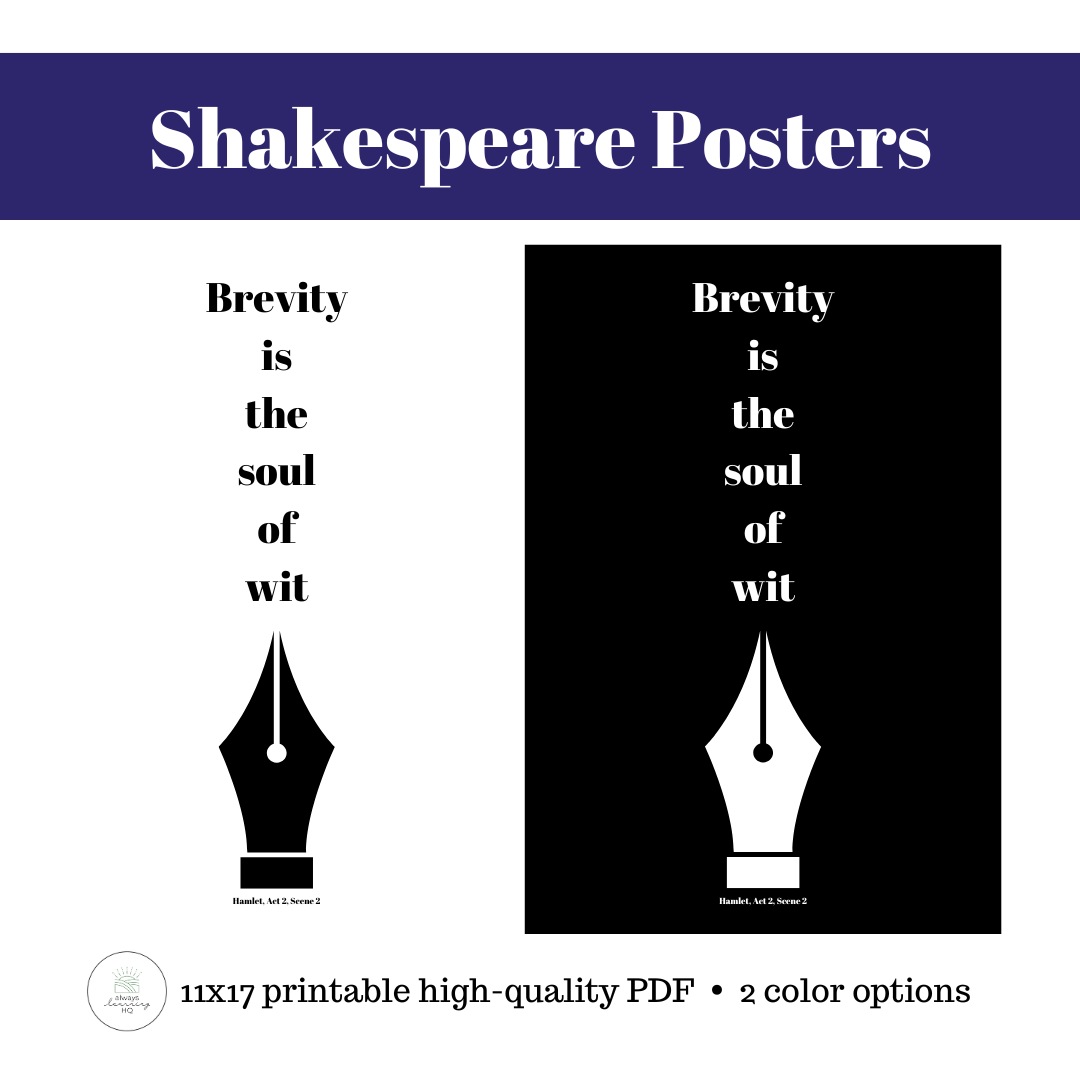
It’s a snow day in the South, so why not make another Shakespeare poster?

Following tradition, this one is out of context but evergreen and ever-true!

Brevity, indeed, is the soul of wit.

Have you read Smart Brevity by Jim VandeHei, Mike Allen, and Roy Schwartz? Fascinating book.

The team is responsible for Politico and, more recently, Axios. In Smart Brevity, they spill the secrets of how to write for brains shaped by the internet. I tried using the Smart Brevity format in work emails. The results were amazing. In just a couple of weeks, people were replying to me in the same format. It is wild!

To every good thing, though, there’s a caveat. The book is a long infomercial for their Smart Brevity AI tool, Axios HQ. I spent the whole [quick] read swinging between “THIS IS AWESOME” and “BLECH.”

There is allegedly a sign hanging on the wall at Axios that says, “Brevity is confidence. Length is fear.” That statement is true, and I love it. But I’m also betting it’s copyrighted, so… for now…

Let’s download and print some Public Domain Shakespeare: Brevity is the soul of wit.

Also… what the what with Act 2, scene 2 of Hamlet, Will?! So many gems!

English/ELA, Faith-Based Resources, Podcasts, Teacher Resources

Atomic Habits + Morning Brew Daily Podcast Guide

PODCAST DAY!

The kiddos love a good Podcast Day. I do too!

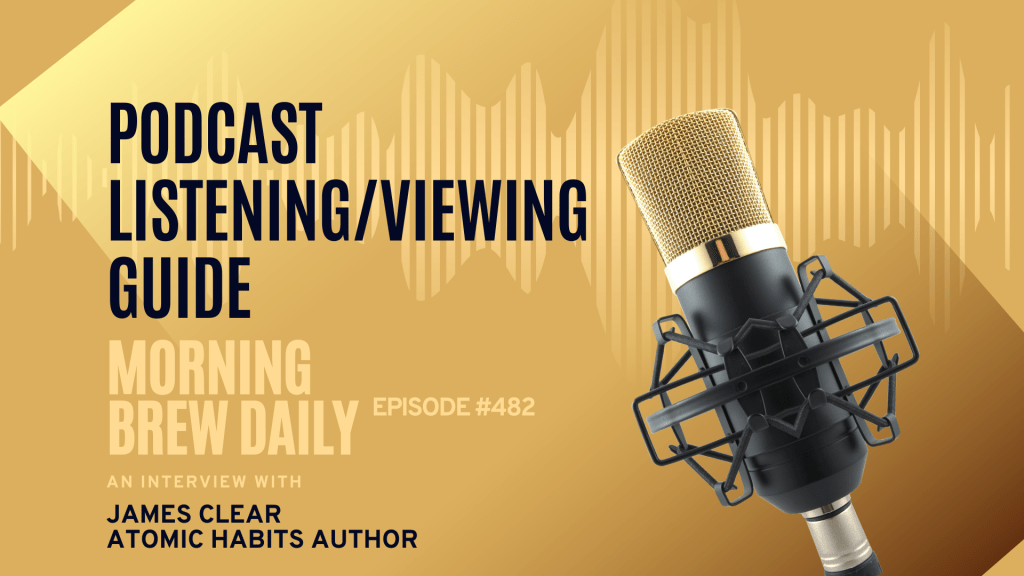
Last week, we watched a replay of a Morning Brew Daily interview where hosts Neal Freyman and Toby Howell talked with Atomic Habits author James Clear about New Year’s resolutions and goal-setting.

The interview originally aired on Jan. 1, 2024, but it’s definitely not a boring leftover from last year. Like spaghetti sauce, homemade soup, and lasagna, this podcast is even better the second time around.

In our Introduction to Journalism & Media class, the students watched the video version of the pod on YouTube in preparation for our upcoming podcast unit. It’s helpful to see interactions between hosts and guests and eye-opening, if you aren’t a podcast watcher, to see how much of podcasting is reading a script.

Podcasting is writing, y’all.

I know it’ll come as a shock, but high school students sometimes think all they have to do is hop on Voice Memos and record 20 minutes of randomness to create top-level content. We’re not tryna be THAT authentic.

Watching professionals shows students the craft of producing listen/view-worthy content.

I love to share, so if you think this activity might be helpful in your classroom, feel free to try it. I’d love to hear how it goes!

Here’s a little resource info based on my experience using this guide with my students…

I structured the guide around the “chapters” identified in the MBD YouTube transcript. The students seemed to find it easy to follow and walked away with solid goal-setting advice they can use irl as they pursue individual goals.

They noticed that Neal and Toby read a script through much of the podcast, but the students also pointed out how closely the hosts listened and that they asked follow-up questions. Turns out podcasting is writing and listening and speaking.

The two-day lesson was a great introduction to our podcasting unit and a challenge to set goals to make the most of the rest of the school year.

Here’s the video we watched…

And here’s the download of the listening/viewing guide…

To all my Christian education friends… we focused a segment of our class discussion on Psalm 90:12 and walked away from the lesson with a renewed commitment to living intentionally as we roll through 2025. Good stuff.

Educators, English/ELA, Media Literacy, Teacher Resources

Fake News: Is This For Real?

Those of you who visit this blog on the regular can probably tell I hit the ground running in the new school year. I always tell myself that the new year will be different, and without fail, it takes less than one week of rolling into the parking lot at the crack of dawn to wipe out every ounce of residual rest from the summer break.

I’ve missed you, though.

It’s fall break now, and the state fair opened today. There’s a frost warning for the area, and the heat is on again for the first time since last spring.

Must be time for an election.

Speaking of elections and the changing of the seasons, there’s one season that never changes—fake news season! We’ve been going strong with fake news since 2016 here in the US.

We’ve been going strong with fake news documentation on planet Earth since *checks note* 1274 BC when Ramses II was the pharaoh of Egypt. If you haven’t read True or False: A CIA Analyst’s Guide to Spotting Fake News by Cindy L. Otis, you’re going to want to head over to your favorite bookstore real quick and grab that one. There’s something strangely comforting in knowing political propaganda has been going strong for millennia.

There is nothing new under the sun, and so far, it keeps rising and setting. Thank you, Lord.

Right before we launched into fall break, our Intro to Journalism & Media class completed a lesson on identifying fake news. The lesson began with students scoping out an article they thought was fake news and doing a preliminary analysis worksheet.

Then we presented tips from media experts on identifying fake news. Turned out some of our articles were, indeed, misinformation (or maybe disinformation, but I’m glad to report disinformation seemed to be harder to find this election year). But an overwhelming number of the articles the students identified as fake news were actually examples of good ol’ media bias.

We’ll be looking at media bias next week. But for now, in case your classes are reeling in the October election frenzy, I’ve uploaded the fake news analysis worksheet and a PDF of the presentation on spotting fake news.

Happy Truth-Hunting!

English/ELA, Social Media, Teacher Resources

Social Media and the Classroom

When I overhauled the curriculum for my Journalism & Media class this past year, I discovered a surprising trend among my students. While most engage with some form of social media (mainly YouTube), not everyone is chronically online anymore.

Culture is shifting, and books like Jonathan Haidt’s The Anxious Generation and platforms like Ben and Erin Napier’s Osprey empower parents to make the call to free their students from unhealthy relationships with smartphones. Some students are grateful, and others seem to feel a little left out. I wanted to normalize both options.

Out of curiosity, I asked the students to share about their social media use. It helped me create better content for my media course and gave me insights into where they consume information and entertainment. My research on these platforms and content creators/brands helped me craft assignments that referenced their culture and encouraged them to engage in classroom activities at a higher rate.

If you teach in a district or school that allows you to survey students about their social media practices (or lack of social media use—that’s important, too), here is a free resource to help you understand more about the digital world that shapes them.

Teacher Resource Reviews, Teacher Resources, Teachers, That Teacher Life

Canva Teacher Certification: A Review

Let’s have a little chat about how Canva is potentially the greatest teaching resource ever created.

I love to create learning materials for my classes, and as much as Microsoft Word templates rocked the previous century and Google Docs rocked the previous decade, Canva is blowing up the world of classroom content creation.

A few weeks ago, I started seeing promoted posts on Instagram teasing that teachers could get Canva certified. I figured it was probably one of those certification courses behind a paywall created by a third party to capitalize on Canva’s success.

But no.

After seeing the post several more times (probably that magical seven times they teach in marketing courses), I decided to investigate.

It turns out the course really is a part of Canva’s Design School. There are seven lessons, complete with tasks to teach you how to maximize Canva in creating classroom and communication resources. You could speed through the videos and skip the tasks, but that would be like racing through Mario without collecting the gold coins.

Can you fly through the mandatory modules and pass the test? Maybe. But that would be seriously short-sighted.

The course content is a trove of gold nuggets allowing you to fly through original content creation, crafting materials for the students sitting in your classroom this year. These tools make customization SO easy.

You can save a ton of time and money (buh-bye, TpT) when you learn how to maximize the full range of teaching tools in the Canva Teacher Essentials course.

Among the gold nuggets you’ll acquire is the magic of turning PDFs into editable documents. Another is translating copy into multiple languages. And magically making a worksheet from a webpage or a poster from a worksheet. You’ll find out how to create and assign content from your Canva resources that will integrate with your school’s LMS. Your students can collaborate with each other, and you can give feedback at all stages of the process on Canva. And the AI tools can even help you brainstorm lesson plans, draft quizzes, and write assignments.

It’s a mile-high pile of gold!

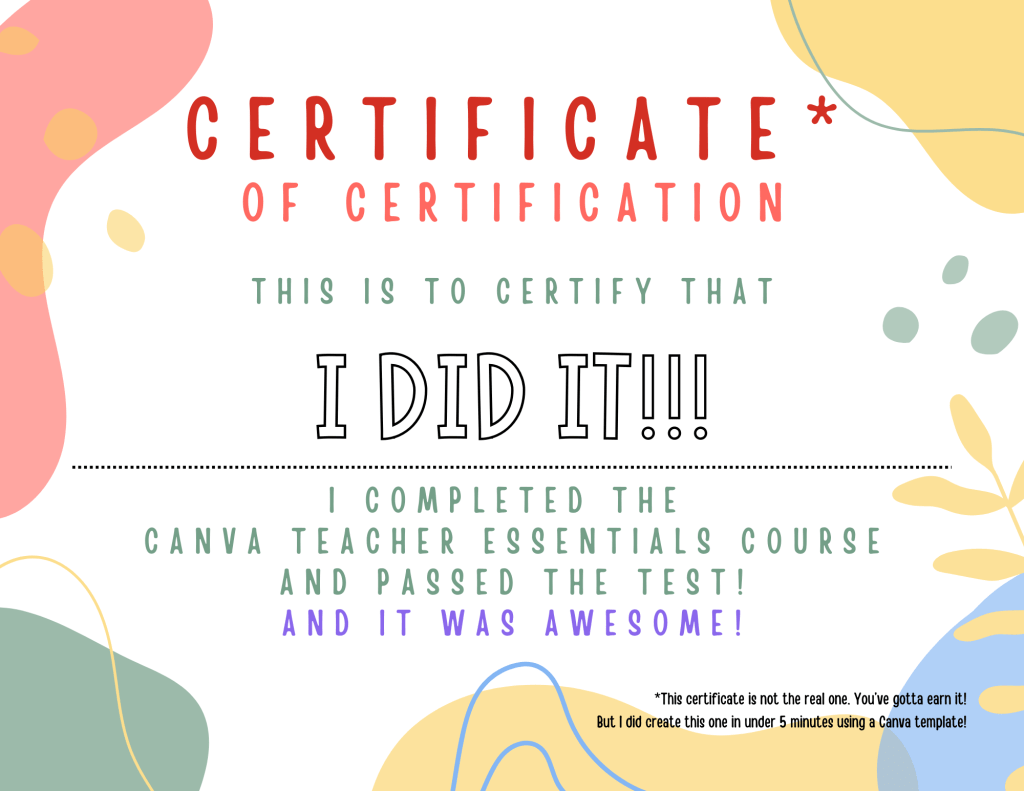
Two things you need to know before jumping out of this blog and onto Canva: first, you have to have a Canva education account to complete the course, and second, I saw somewhere that there was a badge, but I haven’t seen it appear in my inbox yet. I took the course about a week and a half ago. I did get a handy dandy certificate that I could post on LinkedIn, though!

If you’re an educator who takes the course, come back and let me know in the comments what you think was the most valuable skill you learned.

English/ELA, Teacher Resources

O Cursed Deprivation of Sleep

Planning to teach the Tragedy of the Scottish King?

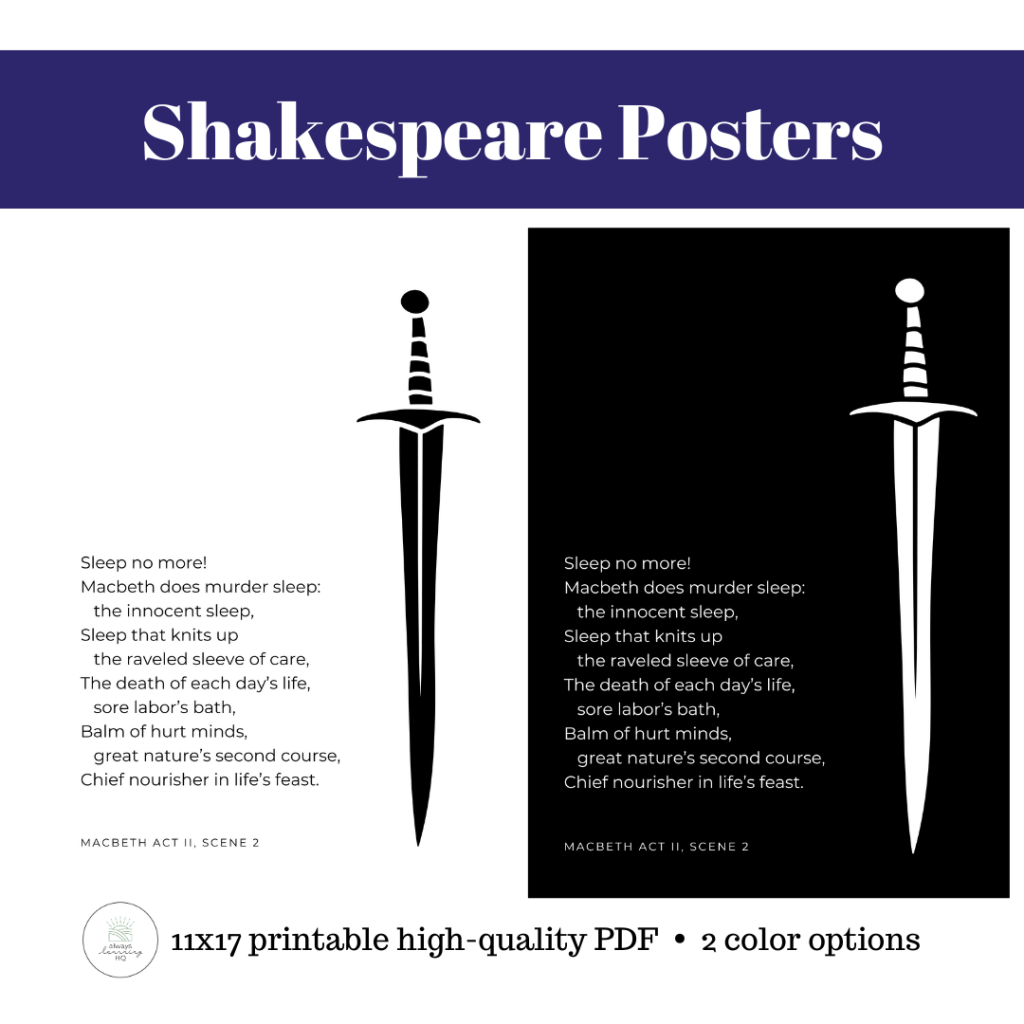
One of my favorite passages that usually gets tucked under the theme of the agonizing consequences of a guilty conscience is in Act 2, scene 2, when Macbeth [SPOLER ALERT] loses his mind after murdering the reigning monarch.

This little gem defining the features and benefits of sleep remains relevant in our overachieving, always striving, nope-hustle-culture-didn’t-die-during-the-pandemic meritocracy.

One of the gut-wrenching aspects of teaching young adults is watching them slip from seasons of sleep deprivation into a lifestyle of sleeplessness.

It stinks when I realize I’ve made the same transition, too.

So hopefully, if you do teach Macbeth, this free poster and analysis worksheet will speed your way toward the “Chief nourisher in life’s feast.”

Sweet dreams!