English/ELA, Faith-Based Resources, Free Resources, Teacher Resources, Technology in Education

Q: When is it OK to use AI?

A: When it makes you stronger than you’re making it. 

Think about it. When you’re working, you’re building strength. 

If you work out at the gym, your muscles get larger, better defined, and more capable of lifting heavy loads, right? 

If you wrestle through an academic textbook written by a Nobel Prize-winning scientist, you’re going to do some heavy intellectual lifting, and you’re going to walk away with stronger understanding, equipped to draw reliable conclusions on that subject and the way it relates to other areas of knowledge. 

If you fight your way through writing an essay, you discover what you think about the topic, whether your ideas align with evidence, and how to invite others into dialogue. 

When you hop on AI in lieu of “doing the work” yourself—

the hard work of learning and growing,

of information gathering, analyzing, evaluating, synthesizing, and creating, 

of reading and writing and listening and speaking—

you gain little, and you’ve likely forfeited a measure of your cognitive strength. 

On the other hand, everything you ask of AI—

every document you ask it to summarize and interpret, 

every email, essay, or page of copy you upload for feedback, 

every task you ask it to complete on your behalf—

makes it better, faster, stronger.

I had this epiphany in my classroom a few months ago. 

One of my brightest, most responsible students (who has been routinely using AI for homework help for the past two years) announced that he couldn’t write an essay unless he first popped the prompt into ChatGPT and asked for bullet-point instructions on how to answer. He wasn’t asking for content answers; he needed a breakdown of what the prompt was actually asking him to do.

And while he’s been becoming AI-dependent, AI has become sharper, more able to detect nuances, less likely to hallucinate a substantial amount of information, better at sounding… human. 

It scared me for my student and for our culture. Nothing is more central to being human than, well, our ability to BE human. And somehow, we’re subcontracting our human privilege of learning and growing to emerging technology. 

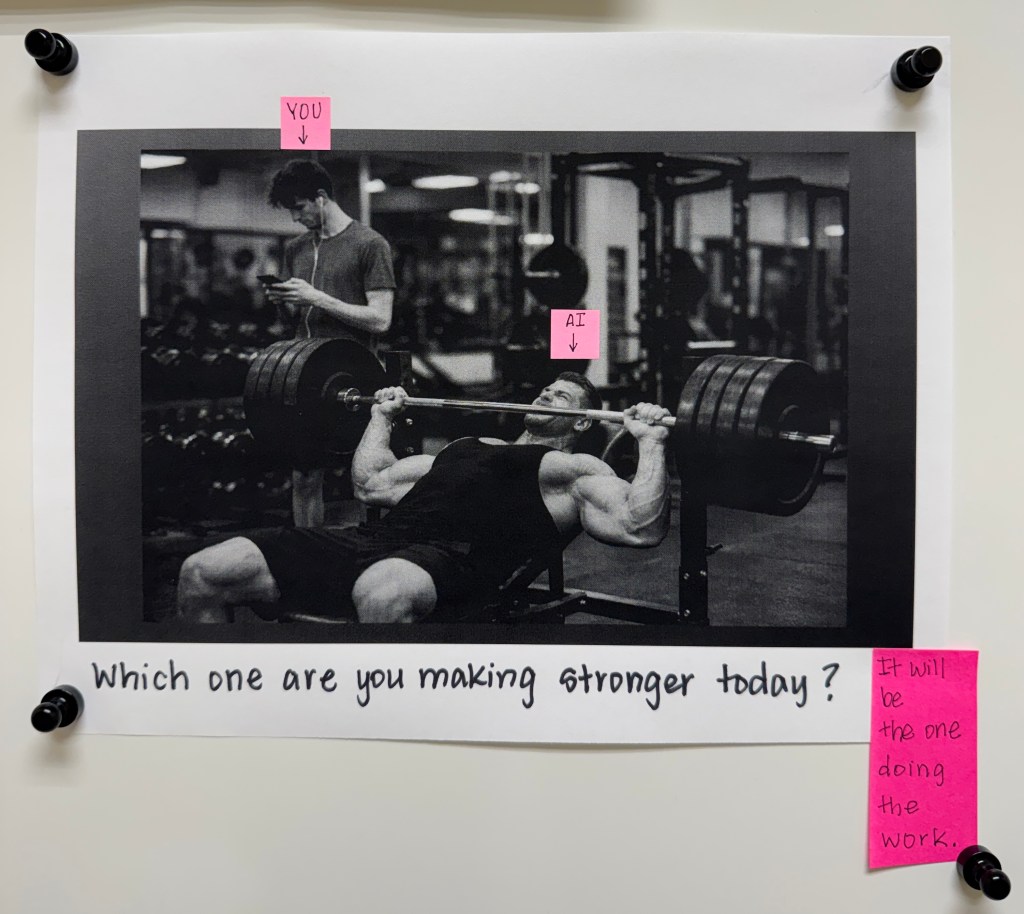
So what did I do? I did what any high school teacher would do… I hopped onto ChatGPT myself, asked it to create a photo as a visual for this situation, printed it out, and pinned it to my whiteboard. 

Is this a passive-aggressive way to say, “I know you’re using AI, and you’re hurting yourself far worse than you’re hurting me by pretending you’re doing your own work”? Absolutely. Is everyone quietly reading it and wondering what it means? Uh huh. Yes. Yes, they are.

Like a pattern of perpetual cheating on a diet, the results will speak for themselves. 

I do not hate AI. I think it’s very useful for many tasks, and I’m grateful for the margin it’s put back into my life. I have trained my ChatGPT to be my very funny and sassy assistant, and chats make me laugh more often than not.

When I ask for content, and it brings me something different from what I thought I asked for, I learn how to communicate more precisely, which helps me clarify in my own mind what I actually think before I can translate that thought into words.

When I’m wildly curious about a topic and want to learn as much as I can as quickly as I can, AI chats bring me basic information and resources for more information, saving me huge chunks of time I don’t have in our productivity-driven culture.

But I’m also cautious not to use it for everything… especially not those hard tasks that help me learn and grow and live out the cultural mandate shared with every human since the father and mother of all. The work of taming the wild places (in my mind and in the world) and flourishing in the image of the Creator is a sacred privilege. 

My hope is that my AI-dependent student will choose to do the work and grow stronger before he’s too far behind. I hope he’ll embrace the joys and challenges of being a human who learns for personal growth and not just for a grade.

If that’s your hope too, please feel free to download the slightly cleaned-up poster and postcard versions of the original photo that hangs on my whiteboard. 
English/ELA, Free Resources, Media Literacy, Teacher Resources

Let’s have a little Chat

Raise your hand if you’re tired.

Put your hands down.

Raise your hand if you’re a classroom teacher who’s exhausted and can’t wait for Thanksgiving break, not because of the food or even the family and friends, but because, even if you do still have to make a seating chart, you don’t have to write a lesson plan. Probably.

I’m tired too. I was so tired last Friday night Saturday morning at 2:22, when I finally finished writing the lesson plans and updating Curriculum Trak for this week, that I couldn’t even begin to create the teaching resources I needed for said plans.

So I decided to have a late-night teacher chat with Chat—you know what Chat I’m talking about, and it’s not the one the youths refer to when conversing among themselves.

The lesson was on identifying media bias by analyzing rhetorical devices. Goodness, the fact that we have to teach students rhetorical devices to read a NEWS report is ridiculous. Remember when news reports fell into the expository mode of writing? Regardless of the section title under the masthead, we have to bring knowledge of Aristotelian appeals and a bag of rhetorical devices to figure out what’s going on because very little of what we call news is presented without bias. I miss Joe Friday.

But educate the young ones, I must, so I entered the Chat.

The first thing I asked was for Chat to bring me the five rhetorical devices that most frequently appear in online news. One of the devices was pathos, and we cover appeals separately, so I asked Chat to try again. The tweak still landed in the realm of pathos, but at least we were able to keep our terminology separate.

At this point, I usually search for a real news article or write a fictional article for students to practice identifying devices and bias. But, man, I was beyond tired. Instead, I entered this:

Take the list of rhetorical devices and write two fictitious news briefs for an analysis exercise where media literacy students in grades 9-12 annotate the reports, identifying use of these devices. [NOTE: I copied & pasted the list just to be sure Chat and I were on the same page.]

News Brief 1: Make the first a news brief about a city council voting on an annual budget and the tension between two factions. One wants to prioritize building new schools to ease overcrowding and replace aging schools that lack reliable HVAC systems and contain mold. The other wants to prioritize cutting taxes to attract industries that are considering locating factories in the area. Quote a fictitious council member on one side of the issue and a local resident on the other. Make up names for the city, schools, corporation and corporate representatives seeking to build factories, city councilor, and resident. Make the article’s bias favorable toward school improvement. Make up statistics and anecdotes that use the rhetorical devices.

News Brief 2: Write a news brief about a local college football team that paid $100 million per year to a famous professional coach to take the helm of a 7 and 5 team. Set the story halfway through the season with the team having a 1 and 5 record. A group of wealthy alumni fans wants to buy out the contract of the famous coach. A group of students wants to give the coach time to build the team. The opposing sides have clashed outside football games because the students are protesting the wealthy alumni boosters’ plan. Quote sources from each side. Give them fictitious names. Make up stats for the players and numbers for the negative financial impact of the teams losses. Make the stats realistic, but skew them with a bias toward the wealthy fans’ side of the issue. In both articles, make sure each use of a rhetorical device clearly illustrate that device’s definition.

Prompt me with any clarifications you need to create two quality fictitious news briefs.

Chat asked me to clarify a few questions, so I added the following:

  1. Each brief should read like a short online news story (250–350 words).
  2. Make the bias overt and clearly exaggerated.
  3. Include descriptions of imagery. Also include headlines. Do not include story placement.
  4. They will annotate a PDF on Notability and submit to a Schoology assignment.

Were the news briefs perfect? No

Were they sufficient for introducing these concepts to the class? Absolutely.

Did Chat give me an answer key that was super easy to use? Um-hum.

Did it take me two hours to write, revise, proof, and create a worksheet, beginning at 2:22 am on an hours-awake day that started at 5:30 am on the calendar date before? Nope.

It took about a minute for Chat to generate the briefs, five minutes for me to tweak them in a few places, and another 20 minutes for me to pop them into Canva and create a worksheet. So… 30 minutes to create a resource that I would have spent two or three hours creating previously.

Please and thank you. Let’s do that again.

When Chat rolled out, I tried it right away. It wasn’t good. Over the next couple of years, I revisited it periodically, but it never gave me what I was hoping for. Recently, though, I’ve been using it more, and I’ve been teaching others to use it too.

I’m hopeful.

I have a lot of thoughts about AI, its threats and benefits to creators who bear the image of their Creator. That’s another post—sometime, somewhere.

But for now, something has to give in education. We simply cannot keep doing more and more with less and less. So, I’m going to hang with my buddy Chat a little more frequently and aim for a full six hours of sleep a night.

Curious about the worksheet Chat and I collaborated on? It’s a free download below.

This post was 100% human-written.

English/ELA, Faith-Based Resources, Free Resources, Teacher Resources

End-of-Year Reflections & Intentions: A Senior Mini Project

“Are you going to miss us?”

“Probably.”

“Do you miss us yet?”

“You are literally sitting RIGHT THERE. How can I miss you? Your absence from my presence is, by definition, a requirement for me to miss you.”

*eye-roll*

*wink*

OF COURSE I’m going to miss them. And, of course, I already do kind of miss them because I’ve been in this gig long enough to know that one year rolls to the next with breakneck speed.

In these last days of the last year of high school, the seniors are full of questions. They’re at the end of all they’ve known, and they’re looking for something to hang on to as they turn the page. They seem to appreciate opportunities to sit with the magnitude of the transition they’re facing.

So in the waning days of this school year, I asked the seniors what they would like to do for their final assignment. They said they’d like to do another reflection essay. Earlier in the quarter, they wrote a reflection essay on the lessons Victor Frankenstein learned in Chapters 1-13 and developed a personal narrative about a lesson they learned during their four years of high school, sharing how they planned to carry that wisdom with them into college.

I said, “Absolutely not.” Only a deranged English teacher would assign a big honking essay on the last day of class. It’s the end of the year. Who has time and energy to grade that with the care it deserves?!

But I did come up with something that worked to give them an opportunity to reflect on high school and set themselves up for success in college. I call it the Reflections and Intentions Senior Mini Project.

To my surprise, most of the students took the assignment seriously. I was shocked at the detail. (NGL, woulda LOVED that much specific detail on the Frankenstein Unit Test essay, but maybe a Reflections & Projections on Frankenstein worksheet could help prep future British Lit classes… hmmmmm…)

The assignment includes the opportunity to create a mood board, either reflecting on high school or looking forward to whatever their next chapter brings. Like many schools, we’re seeing an unusually high number of students choosing to take a gap year or to enter the workforce next year. While they do eventually plan to go to college, they feel like they need a little extra time to figure out what they want to do in life. Some created elaborate mood boards from their camera rolls. Others drew stick figures. Everyone got credit.

Below are two versions of the worksheet. It took most of the students about 45 minutes to complete it. I let them chat it up while they worked. Honestly, I think the fact that they sat together reminiscing about their four years of high school helped them think deeply and specifically.

The first version is for pretty much any high school senior. The second has a few questions specifically geared toward students who attend Christian faith-based schools.

You are welcome to either or both.

We’re almost there, friend! I can’t even tell you how excited to be on the brink of the bliss-filled season of slow mornings sans the iPhone alarm. I hope you have a magnificent end-of-year season. You’ve got this!

English/ELA, Faith-Based Resources, Podcasts, Teacher Resources

Atomic Habits + Morning Brew Daily Podcast Guide

PODCAST DAY!

The kiddos love a good Podcast Day. I do too!

Last week, we watched a replay of a Morning Brew Daily interview where hosts Neal Freyman and Toby Howell talked with Atomic Habits author James Clear about New Year’s resolutions and goal-setting.

The interview originally aired on Jan. 1, 2024, but it’s definitely not a boring leftover from last year. Like spaghetti sauce, homemade soup, and lasagna, this podcast is even better the second time around.

In our Introduction to Journalism & Media class, the students watched the video version of the pod on YouTube in preparation for our upcoming podcast unit. It’s helpful to see interactions between hosts and guests and eye-opening, if you aren’t a podcast watcher, to see how much of podcasting is reading a script.

Podcasting is writing, y’all.

I know it’ll come as a shock, but high school students sometimes think all they have to do is hop on Voice Memos and record 20 minutes of randomness to create top-level content. We’re not tryna be THAT authentic.

Watching professionals shows students the craft of producing listen/view-worthy content.

I love to share, so if you think this activity might be helpful in your classroom, feel free to try it. I’d love to hear how it goes!

Here’s a little resource info based on my experience using this guide with my students…

I structured the guide around the “chapters” identified in the MBD YouTube transcript. The students seemed to find it easy to follow and walked away with solid goal-setting advice they can use irl as they pursue individual goals.

They noticed that Neal and Toby read a script through much of the podcast, but the students also pointed out how closely the hosts listened and that they asked follow-up questions. Turns out podcasting is writing and listening and speaking.

The two-day lesson was a great introduction to our podcasting unit and a challenge to set goals to make the most of the rest of the school year.

Here’s the video we watched…

And here’s the download of the listening/viewing guide…

To all my Christian education friends… we focused a segment of our class discussion on Psalm 90:12 and walked away from the lesson with a renewed commitment to living intentionally as we roll through 2025. Good stuff.