English/ELA, Faith-Based Resources, Free Resources, Teacher Resources

Frankenstein, Ian Malcolm, & Emerging Technology

Did y’all know that a new Frankenstein movie comes out in November?!

It’s releasing on Netflix and looks like it’ll be pretty intense with Guillermo del Toro at the helm of the adaptation.

Coincidentally, when I stepped back into a British Lit classroom to land the plane for the 2024–2025 school year, the final work the seniors studied was Frankenstein.

I teach in a private Christian school, so there are all kinds of lessons about the dangers of playing God that rise to the surface quickly. This work is too perfect to let it go gently into the good night of high school. So, with the goal of making the 19th-century novel relevant to today’s headline-grabbing technologies, I took a gamble.

Instead of launching Frankenstein with the Emerging Technology project as an introductory activity— or saving it for the final assessment—I paused the reading right after Victor runs screaming into the streets when his creature pops in to say “Hi, Dad!” on Creation Day.

We traced Victor’s journey from curiosity to passion, then obsession to possession, and when the consequences of his pride first peeked into the novel on that dark and stormy night, we hit pause.

At the heart of the project is Ian Malcolm’s legendary quote to Dr. Hammond about the hubris of scientific achievement without ethical consideration. That quote inspired the project’s name. (If you haven’t seen the original Jurassic Park movie in a while, take a minute to watch this clip.)

It was a very quick project, two block-schedule days total. We reviewed the presentation, chose groups, researched topics, and presented findings to the class. And oh my word, did those technologies spark some fabulous debates!

Below are PDFs of the resources we used. Students documented their group discussion and research on the worksheets. I counted the worksheets as classwork and the presentations as major assessments.

Please note: The project’s intent was to examine emerging technologies in light of traditional biblical wisdom—to factor in the should along with the could. If that’s not your worldview, you may or may not find this resource helpful.

But if it is, I can’t wait to hear how it goes!

The post photo above is the first slide of the project’s instructional presentation, which uses a template designed by Hope Studio via Canva.
English/ELA, Faith-Based Resources, Free Resources, Teacher Resources

End-of-Year Reflections & Intentions: A Senior Mini Project

“Are you going to miss us?”

“Probably.”

“Do you miss us yet?”

“You are literally sitting RIGHT THERE. How can I miss you? Your absence from my presence is, by definition, a requirement for me to miss you.”

*eye-roll*

*wink*

OF COURSE I’m going to miss them. And, of course, I already do kind of miss them because I’ve been in this gig long enough to know that one year rolls to the next with breakneck speed.

In these last days of the last year of high school, the seniors are full of questions. They’re at the end of all they’ve known, and they’re looking for something to hang on to as they turn the page. They seem to appreciate opportunities to sit with the magnitude of the transition they’re facing.

So in the waning days of this school year, I asked the seniors what they would like to do for their final assignment. They said they’d like to do another reflection essay. Earlier in the quarter, they wrote a reflection essay on the lessons Victor Frankenstein learned in Chapters 1-13 and developed a personal narrative about a lesson they learned during their four years of high school, sharing how they planned to carry that wisdom with them into college.

I said, “Absolutely not.” Only a deranged English teacher would assign a big honking essay on the last day of class. It’s the end of the year. Who has time and energy to grade that with the care it deserves?!

But I did come up with something that worked to give them an opportunity to reflect on high school and set themselves up for success in college. I call it the Reflections and Intentions Senior Mini Project.

To my surprise, most of the students took the assignment seriously. I was shocked at the detail. (NGL, woulda LOVED that much specific detail on the Frankenstein Unit Test essay, but maybe a Reflections & Projections on Frankenstein worksheet could help prep future British Lit classes… hmmmmm…)

The assignment includes the opportunity to create a mood board, either reflecting on high school or looking forward to whatever their next chapter brings. Like many schools, we’re seeing an unusually high number of students choosing to take a gap year or to enter the workforce next year. While they do eventually plan to go to college, they feel like they need a little extra time to figure out what they want to do in life. Some created elaborate mood boards from their camera rolls. Others drew stick figures. Everyone got credit.

Below are two versions of the worksheet. It took most of the students about 45 minutes to complete it. I let them chat it up while they worked. Honestly, I think the fact that they sat together reminiscing about their four years of high school helped them think deeply and specifically.

The first version is for pretty much any high school senior. The second has a few questions specifically geared toward students who attend Christian faith-based schools.

You are welcome to either or both.

We’re almost there, friend! I can’t even tell you how excited to be on the brink of the bliss-filled season of slow mornings sans the iPhone alarm. I hope you have a magnificent end-of-year season. You’ve got this!

English/ELA, Faith-Based Resources, Podcasts, Teacher Resources

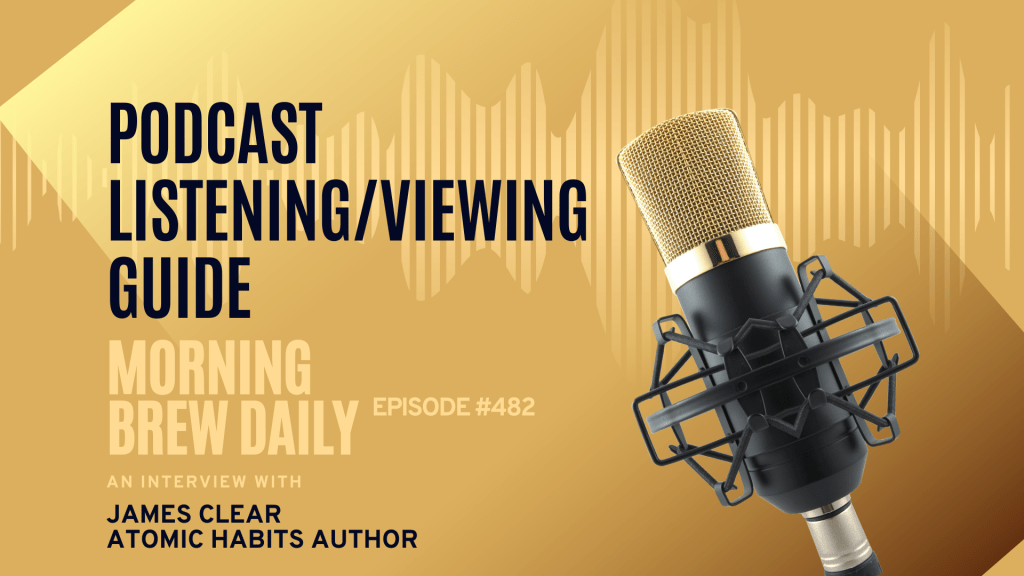
Atomic Habits + Morning Brew Daily Podcast Guide

PODCAST DAY!

The kiddos love a good Podcast Day. I do too!

Last week, we watched a replay of a Morning Brew Daily interview where hosts Neal Freyman and Toby Howell talked with Atomic Habits author James Clear about New Year’s resolutions and goal-setting.

The interview originally aired on Jan. 1, 2024, but it’s definitely not a boring leftover from last year. Like spaghetti sauce, homemade soup, and lasagna, this podcast is even better the second time around.

In our Introduction to Journalism & Media class, the students watched the video version of the pod on YouTube in preparation for our upcoming podcast unit. It’s helpful to see interactions between hosts and guests and eye-opening, if you aren’t a podcast watcher, to see how much of podcasting is reading a script.

Podcasting is writing, y’all.

I know it’ll come as a shock, but high school students sometimes think all they have to do is hop on Voice Memos and record 20 minutes of randomness to create top-level content. We’re not tryna be THAT authentic.

Watching professionals shows students the craft of producing listen/view-worthy content.

I love to share, so if you think this activity might be helpful in your classroom, feel free to try it. I’d love to hear how it goes!

Here’s a little resource info based on my experience using this guide with my students…

I structured the guide around the “chapters” identified in the MBD YouTube transcript. The students seemed to find it easy to follow and walked away with solid goal-setting advice they can use irl as they pursue individual goals.

They noticed that Neal and Toby read a script through much of the podcast, but the students also pointed out how closely the hosts listened and that they asked follow-up questions. Turns out podcasting is writing and listening and speaking.

The two-day lesson was a great introduction to our podcasting unit and a challenge to set goals to make the most of the rest of the school year.

Here’s the video we watched…

And here’s the download of the listening/viewing guide…

To all my Christian education friends… we focused a segment of our class discussion on Psalm 90:12 and walked away from the lesson with a renewed commitment to living intentionally as we roll through 2025. Good stuff.

English/ELA, Faith-Based Resources, Teacher Resources

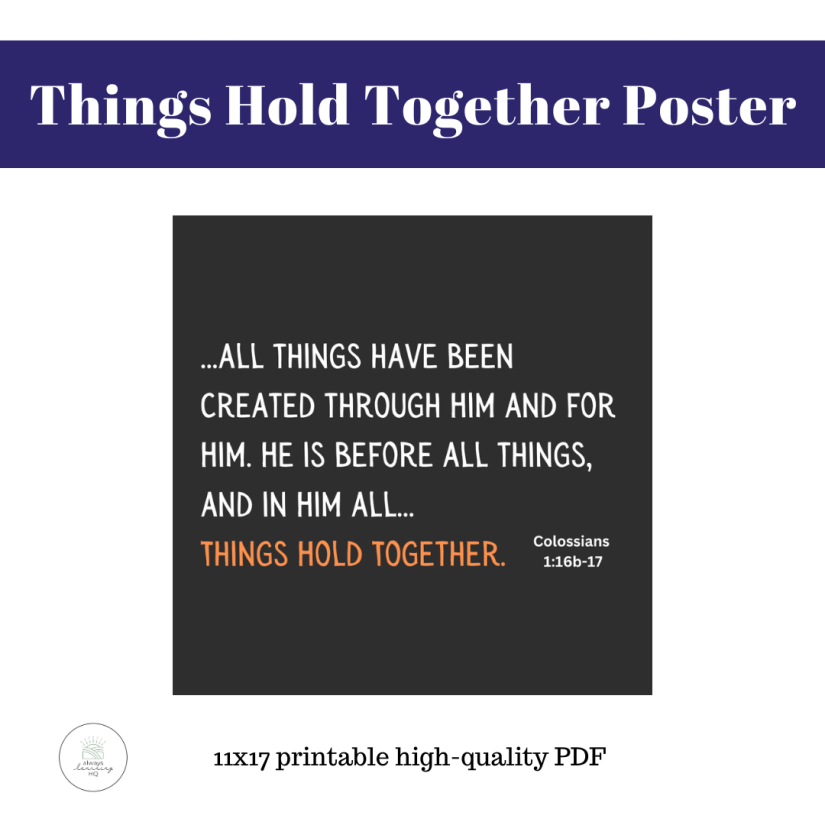
Things Hold Together

Several years ago, when I was teaching Things Fall Apart, one thing that kept hitting me over and over was the tension in Okonkwo’s life even before the arrival of the Europeans.

He’s a brilliantly crafted character—so great in his culture but so at odds with it, too. His identity is built on what he perceives to be the most important cultural values, strength and fearlessness. Yet fear certainly overshadows his thoughts and actions, and he does cruel and ruthless things to prove his unmatched strength and control. Ultimately, the culture proves cruel and ruthless toward him as well.

Clearly, the cultural shift that happened with the arrival of the Europeans hastened Okonkwo’s downfall, but there were already cracks in the life he’d built for himself.

We approached the novel through the lens of cultural and character analysis, tracking elements of Ibo (Igbo) and European cultures and the internal and external traits of the main characters. In the end, our goal was to determine the degree of impact culture and character had on each other.

I need to mention that I taught Things Fall Apart at a private Christian school and that I am a follower of Jesus Christ. That’s a key detail in this story.

As we compiled our lists of cultural elements and examined how the characters embodied their respective cultures, I had an epiphany. Or maybe two.

First, I realized that even though religion is an element of culture, there is a huge difference between culture-based Christianity and what C.S. Lewis would call “mere Christianity”… the essence of the faith apart from a particular culture.

Second, it dawned on me just how tightly the threads of my American culture and faith had woven together without my awareness. It was shocking, and I spent the next few years questioning my assumptions about faith, culture, and the connection between the two.

As I journeyed through this season, the threads of pure faith in Jesus and what it looks like to be His disciple unwound from the values my culture dictated as most important.

As challenges came and the larger culture shifted in a direction I just could not go, my foundation remained solid. The Spirit used literature to show me the cracks in the life I’d built for myself. This season led me through a major course correction.

During this time, I made a chalk-painted sign with the words of Colossians 1:16b-17 (NIV) and hung it in my classroom to remind me that anything I build my life on besides Jesus will ultimately let me down. It also became a reminder to my high school students that there’s a better foundation for their lives, a surer foundation, than the ever-shifting sands of their culture.

So, that’s the origin story for this resource.

If you happen to teach at a Christian school where students read Things Fall Apart in your English class, here’s a free poster to pair with the Yeats & Mere Anarchy poster I shared a few weeks ago. Even if you don’t teach in a Christian school where students read Things Fall Apart in your English class, you are welcome to this resource. Because it’s true: in the world, things fall apart, but in Jesus, all things hold together.