In paragraph form, narrate the process of washing hands. Go methodically through the steps, but try to avoid using the actual words, “Step one, step two,” etc. Let the directions flow in story form, but don’t add characters or other details. Just show the process.
Prompt #6: Challenges:
Wait… what? More than one challenge?! Yes, yes, there are TWO challenges for this one, but you need to choose only one of the two–the one that suits you best.
Collaborative Challenge:
Grab a partner or two and ask them to help you with a little experiment. You’ll read your Prompt #6 step-by-step instructions for washing hands, and your partner(s) will, in real life, do EXACTLY what you wrote. And I mean EXACTLY. Instruct your collaborative team not to do anything that isn’t included in the words you wrote. If things get weird, you’ll know you missed some steps. Once everyone stops laughing, revise your paragraph and try the same experiment on a new person to see how well your revision went.
Solo Challenge:
Take the hand-washing paragraph you have written and add in the thoughts of the person washing their hands. If the person is you, then write what you would think as you wash your hands. If the hand-washer is someone other than you, make their thoughts consistent with who they are and their context. In either case, feel free to bring in a narrative frame.
For this solo challenge, experiment with form. Do you want to put thoughts in italics? Although if someone is handwriting the prompt, I suppose underlining would be best. Do you prefer to introduce thoughts directly? I wondered as I became conscious of just how cold my hands actually were.
Let me know how it goes. I can’t wait to read these. Upload your writing in the comments.
Not sure what’s going on with these “On Wednesdays We Write” prompts? Click here to find out.
Glory. What is glory? Take a few minutes to reflect. It’s OK to use a dictionary or to Google the meaning. How does glory look? Sound? Smell? Taste? Feel? How do you know when you achieve glory? What items would be on the checklist? Does glory come from within, or does another’s attention or praise bring glory? Is it a conscious goal or a byproduct? Share briefly an encounter you’ve had with glory.
Prompt #4 – Challenge:
Write a poem titled “Glory” that conveys the essence of the word.
Poetic form: whatever works
Suggested length: as long as it takes
Share your prompt responses by uploading in the comments.
Not sure what’s going on with these “On Wednesdays We Write” prompts? Click here to find out.
That’s right. The Common App announced the 2021-2022 prompts this week, and this year there is a NEW option in the lineup.
Reflect on something that someone has done for you that has made you happy or thankful in a surprising way. How has this gratitude affected or motivated you?
The new prompt replaces the problem-solving prompt for two reasons. First, the option to write about a problem you would solve was one of the least selected choices. And second, the Common App cites research demonstrating the benefits of writing about the positive influence of others on our lives. And who couldn’t use some positivity?!
The rest of the prompts remain the same as 2020-2021. The optional COVID-19 question remains in the Additional Information section, which makes sense since the pandemic is still having a significant impact on the planet.
To read more about the 2021-2022 Common App essay changes, click here.
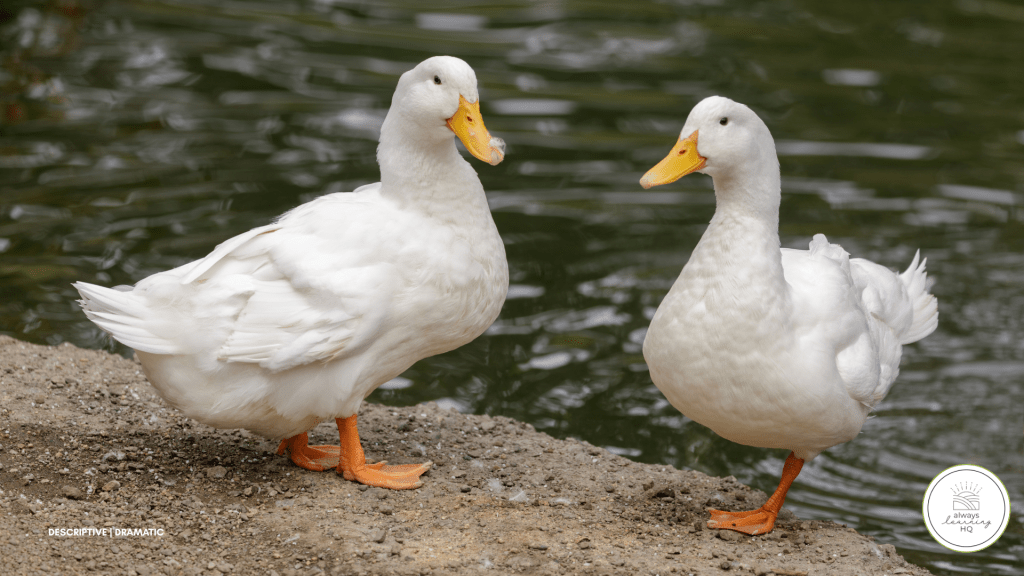
Write a dialogue between these two ducks that introduces and resolves a conflict. If read out loud, the conversation should last 3-4 minutes.
Prompt #3 – Challenge:
Write an introduction to the duck exchange, except for this challenge, make the same conversation between humans. Give the characters names, brief physical descriptions, and internal traits that set up the dialogue to make sense. Follow the introduction with a revised version of the duck dialogue that fits the human characters you’ve created.
I’m excited to read what you’ve created. Upload your exercise in the comments to share.
Not sure what’s going on with these “On Wednesdays We Write” prompts? Click here to find out.
Write the exposition for a story that begins with the following:
When I opened my eyes, I struggled for a minute to figure out whether I was dreaming or awake…
Remember that exposition gives the background for a story. It introduces characters and setting (time and place), as well as the situation in which the characters find themselves.
Prompt #2 – Challenge:
Advance the story through the inciting incident, which is the event that reveals the conflict and draws the main character into their journey.
I’m looking forward to reading your stories. Upload your work in the comments to share.
Not sure what’s going on with these “On Wednesdays We Write” prompts? Click here to find out.
Tell me about your favorite fork. Describe what it looks like. What color is it? What shape? Of what material is it made? Detail any engravings or decorative features. Is it one-of-a-kind or one of many? How does it feel when you hold it? Why is this one your favorite? What people, events, ideas, or emotions do you associate with it?
Prompt #1 – Challenge:
Write a vignette featuring this fork. A vignette is a very short sequence of events, creating a snapshot of one brief moment in time. Work in as many descriptive details as you can, but remember to place them in a narrative.
The narrative may be fiction or nonfiction.
Suggested length: 300-400 words
Upload your writing in the comments to share.
Not sure what’s going on with these “On Wednesdays We Write” prompts? Click here to find out.
Starting this week, we’re writing together every Wednesday.
Now that we’re solidly past the season of New Year’s resolutions and goal-setting let’s do something fun. Something good for the soul and heart and intellect. Let’s write!
We’re not writing with immediate, focused goals in mind. Instead, we’re writing to discover and to become better writers.
Each Wednesday, I will post a writing prompt and a challenge based on that prompt. Think of the prompt as a springboard. You might want to jump, fly through the air, and land. That’s it. You’re done. But if you want more writing, more jumping and flying and landing in a different place, then move to the challenge for an additional writing opportunity.
Do whatever you’re up for. It’s completely up to you.
If you are a writer, look at “On Wednesdays We Write” as a respite from your current project. With great mindfulness, focus on the actual writing and not what you will do with it. Let the exercise be an end in itself. Delight in the ideas and images and words. It’s your chance to do what you love without pressure. I hope that these little exercises will take you back to your goal-oriented, deadline-focused writing with peace and refreshment, as well as energy and strength.
If you are a teacher, feel free to use these posts as bellringers, supplemental activities, journal entries, prewriting exercises, or even writing assignments. I challenge you to give students the chance to write for fun. Treat it as play, not work. At your discretion (you know your students better than anyone else), choose students to share their writing aloud, whether in person or remotely. Or publish their submissions in a collaborative document or even in a digital literary magazine. Want to up the ante for successful completion? You write the prompt too, and if 100% of students participate, then share your writing.
If you are a student, you can write without a teacher assigning these! Whether you’re super-eager to learn or just super-bored, these prompts will give you a chance to explore your world and your ideas. You’ll practice organizing details and creating an engaging reading experience for your audience. Post your responses to these exercises on your blog and link back to these prompts so your writing community can join you. Ask a friend or two to write the prompts with you and share your writings each week.
I’m excited for all the writing fun that lies ahead, and do you know what would make me over-the-top thrilled? Post your response to the writing exercises in the comments. I would LOVE to read what you write.
Are you ready to get started? I’ll see you on Wednesday!
Sarah Koenig changed everything with Season One of the “Serial” podcast.
Before “Serial,” most of us were content to listen to “This American Life” on NPR. Occasionally, we might visit the website. But when Sarah Koenig began to unwrap the saga of Adnan Syed, we consumed journalistic storytelling with abandon. We learned where podcasts lived, and then we subscribed, listened, binged, occasionally rated, and subscribed some more.
Podcasts worked their way front-and-center onto our media consumption menu. Podcasts didn’t require listeners to WATCH and listen, so people could drive, walk, or jog and still experience investigative reporting or creative cultural analysis or sassy social commentary or just about anything else.
Podcasts gave great storytellers a platform and an audience. Podcasts also gave some not-so-great storytellers a platform and an audience too.
Listening is one of the four core language arts. Along with reading, writing, and speaking, listening gives us a tool for educating ourselves to engage in public dialogue.
In the high school English classroom, listening skills have traditionally shown up in the form of audiobooks and classroom speeches. However, the proliferation of podcasts gives high school teachers a new realm of opportunities to teach their students critical listening skills.
Episodic investigative journalism podcasts that focus on one story told in many parts are largely enthralling and binge-worthy. Season One of “Serial” was like watching a novelist, week-by-week, figure out what story she was telling. We got to see characters develop and the plot unfold. Except “Serial” was real-life and the characters were real people and the plot didn’t resolve in a neat and tidy manner or in a timely fashion. The story of the first season of “Serial” is still working itself out.
In contrast to investigative storytelling, largely for entertainment purposes, is the science of daily newscasting in podcast format. At the pinnacle of daily news podcasting is “The Daily,” produced by The New York Times. Hosted by Michael Barbaro, “The Daily” tackles one long news story each episode. Using sound bites and sound effects, along with music that keeps listeners slightly off-balance with the way it lightens the mood of even the darkest stories, “The Daily” takes a deep dive into the complexities of current events and cultural phenomena.
Barbaro typically interviews a New York Times reporter, who shares background and analysis of the topic of the day. Each episode is rich with information, and at a point in our national history when everything in media seems designed to spin towards an extreme of the political spectrum, “The Daily” always manages to acknowledge what is at stake on all sides of the event or phenomenon.
The reporters are tenacious, intelligent, and eloquent. Barbaro serves as an engaged Everyman, asking “So what does this mean?” and restating the information while adding analysis—“So let me get this right… If… then… And that’s the chief concern.”
While the trend toward using podcasts as curriculum content in the classroom has been around for a few years, thanks to Koenig, the potential use of podcast analysis as curriculum enrichment has risen as another pillar of listening instruction. Episodes of “The Daily” pair nicely with the high school English class curriculum. The theme of the corrupting influence of power runs broad in current events and culture. Elections, social media giants, international business practices, crises of conscience… they all play into the idea that power corrupts and absolute power corrupts absolutely.
Literature is effective in pointing out to students the great ideas that shape our world and our character. Daily new podcasts give students specific examples where truths revealed in literature are truths that run through the real world.
To help students analyze “The Daily” podcast content, I made a worksheet. Teachers can use the worksheet to help students analyze a current event or cultural phenomenon presented on “The Daily” as an end to itself. For this purpose, teachers can focus on hows and whys of the episode topic, giving students room to express their own opinions on the subject and evaluate the effectiveness of the podcast.
Or the analytical worksheet could be the springboard for understanding the event or phenomenon in order to draw parallels between real life and literature.









 Always Learning HQ