
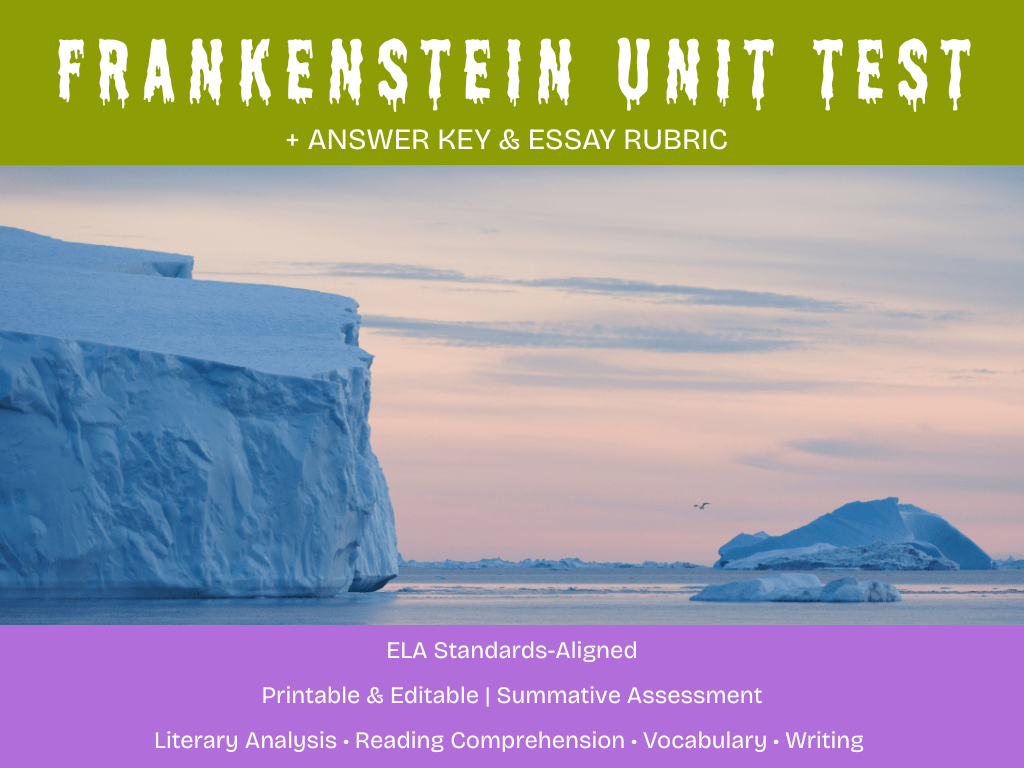
I sat down one day last spring with my annotated copy of Frankenstein, and EIGHT short HOURS later—voila! A FrankenTest was born created written. Human-written. By me. An actual human person.
On the last episode of Creating Resources with Always Learning HQ, I was playing with AI as a shortcut for writing media-bias practice passages. I needed something less triggering than real-life politics, sports, entertainment, or news for my students to get some reps identifying rhetorical elements in news writing. Don’t worry. Later, there was a major assessment involving real-life news articles. We just needed a little guided practice with some actual fake news before wandering into the wilderness of the current media landscape.
But for the FrankenTest, I went hardcore old school: just me in my office with a scandalous amount of coffee, a bag of Hershey’s Kisses, my teaching copy of the novel, a laptop, and my brain. At the end of the literal day, I was exhausted, but the product was totally worth it.
When my seniors took the test, the grades were everything I’d hoped. Students who read and annotated the novel scored in the high 90s. Students who studied summaries or practiced using AI chats scored from the mid 50s to low 70s.
You see, at their core, English literature tests are reading tests. Of course, it helps to read the actual book, but many students can get the objective elements (and some analysis) from online sources. And what they don’t learn on summary sites or through AI, they pick up on as they tune in to class discussions.
What they can’t do without actually reading the novel is adapt their brains to the writing style. That’s what makes this unit test a challenge. Obviously, Mary Shelley did not write the test. I did, with my coffee and Hershey’s Kisses. But some of Shelley’s language patterns and diction echo through the assessment. So students who read or listened to the novel did well, and students who also annotated did GREAT.
I’m excited for you to see this resource. Normally, you’d scroll to the bottom of the post to download a PDF of the resource. Not this time, though, and that kind of hurts my heart because I really love sharing free teacher resources.
For the sake of test security, the FrankenTest lives behind a paywall on Teachers Pay Teachers (answer key and essay rubric included). If you’re interested, there’s a decent preview on the listing.
More free stuff for classroom activities is coming soon to AlwaysLearningHQ.com. So keep checking back from time to time. I’m cleaning out the proverbial attic of resources from across four decades of teaching and putting each in one of four bins: keep, trash, donate, and sell.
It’ll be fun to see what lands here next. Hopefully, it won’t be a monster!
 Always Learning HQ